
What should I look for when choosing a drilling contractor?
Over 53 million Americans obtain their drinking water from private wells each day. Because of this great demand, extra care has to be taken in obtaining and using this most precious resource. As a licensed contractor, we take extra measures to be certain that your private water system is properly constructed. With proper installation and maintenance, as well as proper treatment (if necessary), your private water supply can be better than water from a municipal water supply. Municipal water is sometimes obtained from local rivers, streams or lakes. Water from these sources can often contain harmful bacteria and other undesirable contaminants. Municipal water supplies have known for years that this water had to be disinfected by chlorination to prevent illness. After treatment, these supplies are generally not perfect, but are usually free from harmful bacteria and are generally acceptable for consumer use. Water from municipal supplies often has objectionable odors and taste. Through your own private water supply, you are in control of what chemicals, if any, are added to your water supply. There are no monthly water bills to pay and you have the security of knowing that you are in control of your family’s water usage demands. If for some reason bacteria is introduced into your well system, well disinfection is rather simple and can be followed up with an Ultraviolet Sterilization for added security.
Over 53 million Americans obtain their drinking water from private wells each day. Because of this great demand, extra care has to be taken in obtaining and using this most precious resource. As a licensed contractor, we take extra measures to be certain that your private water system is properly constructed. With proper installation and maintenance, as well as proper treatment (if necessary), your private water supply can be better than water from a municipal water supply. Municipal water is sometimes obtained from local rivers, streams or lakes. Water from these sources can often contain harmful bacteria and other undesirable contaminants. Municipal water supplies have known for years that this water had to be disinfected by chlorination to prevent illness. After treatment, these supplies are generally not perfect, but are usually free from harmful bacteria and are generally acceptable for consumer use. Water from municipal supplies often has objectionable odors and taste. Through your own private water supply, you are in control of what chemicals, if any, are added to your water supply. There are no monthly water bills to pay and you have the security of knowing that you are in control of your family’s water usage demands. If for some reason bacteria is introduced into your well system, well disinfection is rather simple and can be followed up with an Ultraviolet Sterilization for added security.
Is well water as safe as utility water?
Anyone drilling wells, installing pump systems, or installing water treatment systems in the state of Tennessee is required to be licensed. Check a contractor’s reputation by asking neighbors and friends about prior business dealings. Check with the Better Business Bureau and State of Tennessee Department of Water Supply. Make sure the contractor doesn’t pay his/her employees footage bonuses. Make sure the contractor has general liability insurance and workers compensation to protect you from injury that could occur on the job site. Does the contractor run a full-service business, providing well drilling, submersible pump installation/repair, and water treatment solutions? With over 68 years experiences you can trust that Joe Samples Well Drilling, Inc. surpasses all the criteria in looking for a superior well drilling contractor.
Anyone drilling wells, installing pump systems, or installing water treatment systems in the state of Tennessee is required to be licensed. Check a contractor’s reputation by asking neighbors and friends about prior business dealings. Check with the Better Business Bureau and State of Tennessee Department of Water Supply. Make sure the contractor doesn’t pay his/her employees footage bonuses. Make sure the contractor has general liability insurance and workers compensation to protect you from injury that could occur on the job site. Does the contractor run a full-service business, providing well drilling, submersible pump installation/repair, and water treatment solutions? With over 68 years experiences you can trust that Joe Samples Well Drilling, Inc. surpasses all the criteria in looking for a superior well drilling contractor.
Do I need a permit for a well?
No, there is no permit requirement to have a water well drilled. However, the State of Tennessee has a registration procedure we abide by. In this procedure, we as a licensed well driller must submit a $75.00 fee to record your well data. This needs to be in the form of a check made payable to Joe Samples Well Drilling, Inc. Once contracts have been completed by the homeowner, we will send this information to the state and you are assigned a well ID number. Your well will then be registered with the state and subject to inspection to make sure that it meets construction standards.
No, there is no permit requirement to have a water well drilled. However, the State of Tennessee has a registration procedure we abide by. In this procedure, we as a licensed well driller must submit a $75.00 fee to record your well data. This needs to be in the form of a check made payable to Joe Samples Well Drilling, Inc. Once contracts have been completed by the homeowner, we will send this information to the state and you are assigned a well ID number. Your well will then be registered with the state and subject to inspection to make sure that it meets construction standards.
How do I know how deep my well will be?
It is almost impossible to know the depth of a given well before the drilling begins. The easiest way to get a good estimation is to contact neighbors and find out their well depths. You can also contact Joe Samples Well Drilling for information on wells that have been drilled in your area. We have our own database with well information dating back to 1969 as well as access to a State database with recorded well information. We can use this to provide you with information such as: average well depths, average casing footage, average water yields and potential water quality in your area.
It is almost impossible to know the depth of a given well before the drilling begins. The easiest way to get a good estimation is to contact neighbors and find out their well depths. You can also contact Joe Samples Well Drilling for information on wells that have been drilled in your area. We have our own database with well information dating back to 1969 as well as access to a State database with recorded well information. We can use this to provide you with information such as: average well depths, average casing footage, average water yields and potential water quality in your area.
Where should I drill my well?
Water can be found almost anywhere in the Eastern Tennessee Area. Your well should be located higher than any point of contamination such as septic tanks or where water will flood and stand. State regulations require that the well location be at least:
Due to the size and expense of the drilling equipment proper site access and preparation must be in place to ensure your well can be drilled in the location you prefer.
Our rigs are about 40 feet long, 10 feet wide and weigh around 70,000 pounds fully loaded. Due to the size of the drill, drill tender/water truck, and support vehicles proper site preparation and access is of utmost importance. This is especially true during the fall/winter/spring months when rainfall makes it difficult to move equipment this size. Proper road construction, to allow access to the property, and site preparation (a relatively flat location where the equipment to construct the borehole will be set up) will ensure that we are able to perform the drilling process. Not only does it keep our employees and equipment safe, but proper accessibility allows us to get equipment in and out in a more timely fashion. A site that can be accessed at any time gives us the opportunity to prioritize during rainy seasons.
Water can be found almost anywhere in the Eastern Tennessee Area. Your well should be located higher than any point of contamination such as septic tanks or where water will flood and stand. State regulations require that the well location be at least:
- 25 ft. from property lines
- 50 ft. from septic tank, sewer lines, and drain fields
- 5 ft. from building foundations
- 100 ft. from animal pens (feed lots)
Due to the size and expense of the drilling equipment proper site access and preparation must be in place to ensure your well can be drilled in the location you prefer.
Our rigs are about 40 feet long, 10 feet wide and weigh around 70,000 pounds fully loaded. Due to the size of the drill, drill tender/water truck, and support vehicles proper site preparation and access is of utmost importance. This is especially true during the fall/winter/spring months when rainfall makes it difficult to move equipment this size. Proper road construction, to allow access to the property, and site preparation (a relatively flat location where the equipment to construct the borehole will be set up) will ensure that we are able to perform the drilling process. Not only does it keep our employees and equipment safe, but proper accessibility allows us to get equipment in and out in a more timely fashion. A site that can be accessed at any time gives us the opportunity to prioritize during rainy seasons.
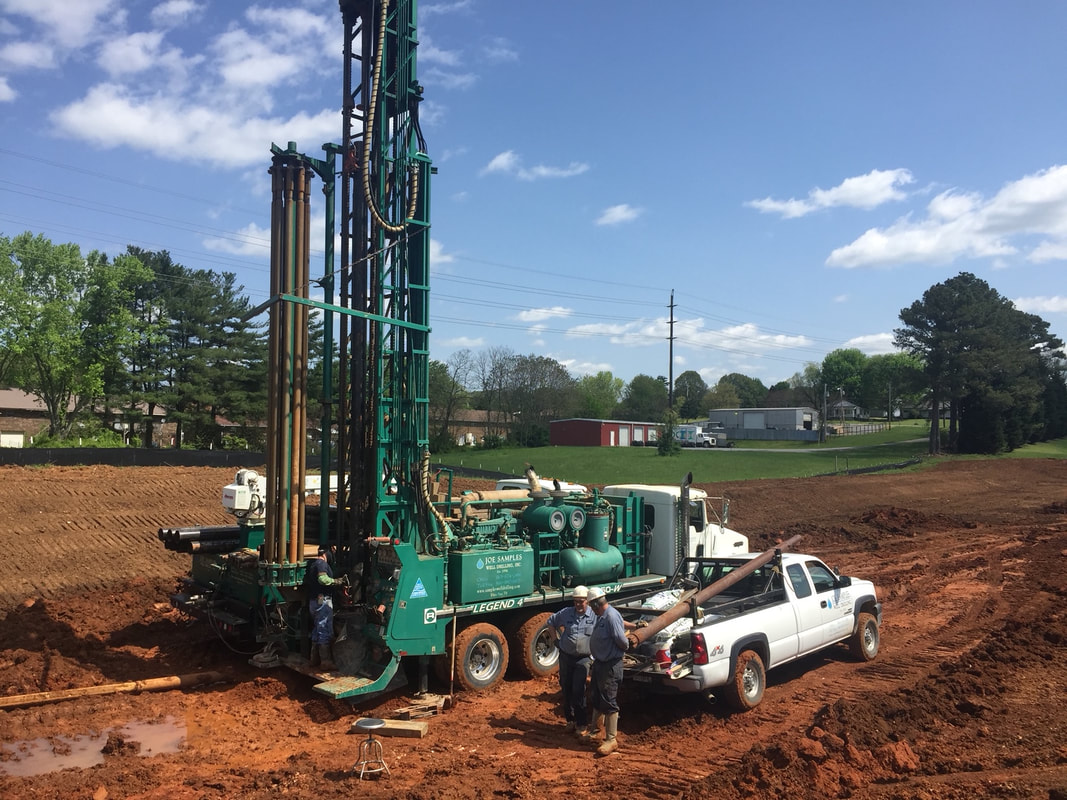
The above picture is a great example of a good level site to be able to drill. It is also an example of poor site access with no proper road for ingress/egress. Without a road, properly graveled, additional equipment is needed to get the equipment to the spot and back out. This only increases the cost of the overall process.
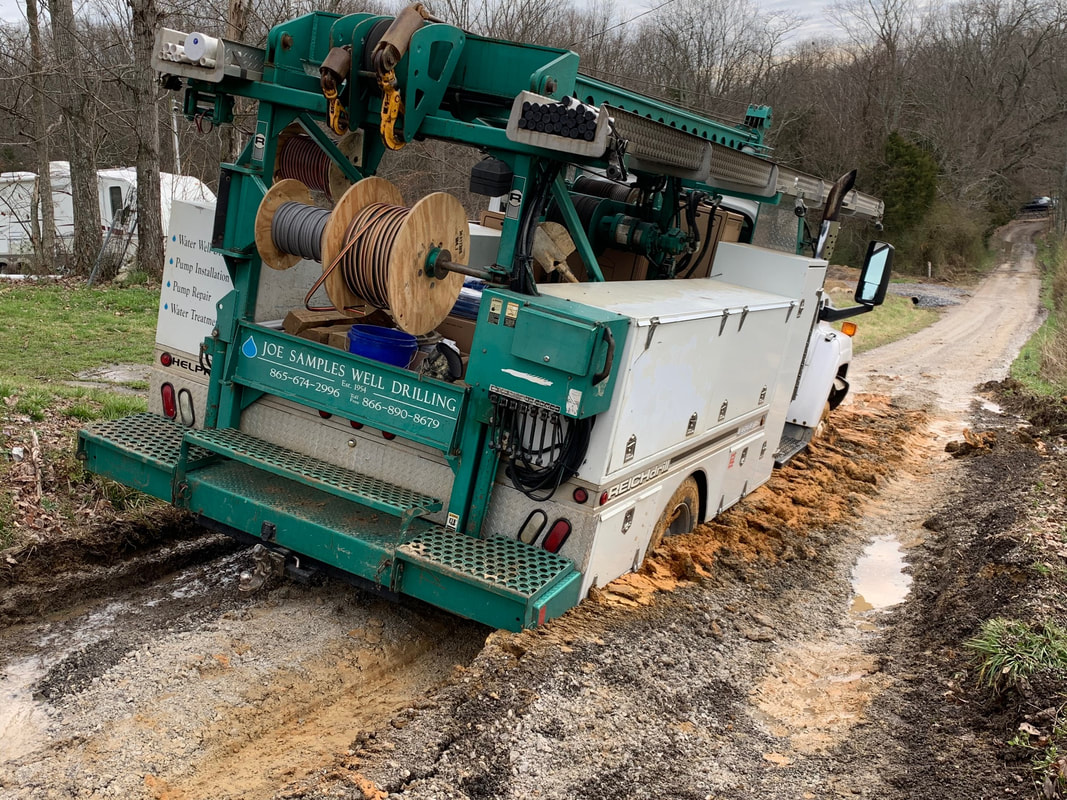
The above picture is a great example of an improperly constructed roadway. The weight of our equipment cannot be underestimated. This is one of our smaller service vehicles but an improperly constructed roadway resulted in stuck equipment and additional costs to retrieve the vehicle.
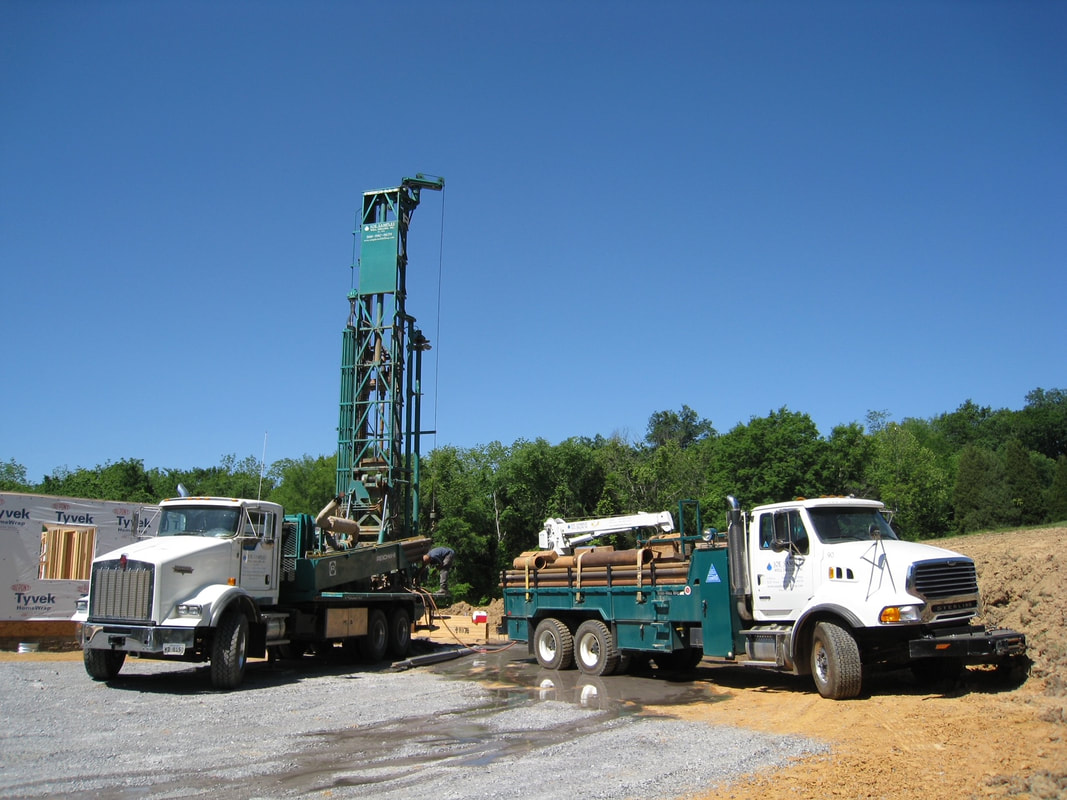
The above picture is a good example of properly prepared site access and site preparation. Solid roadway with gravel base and a flat drilling site ensures your well is drilled without incurring unnecessary costs in relation to site ingress/egress.
Now that my well is drilled, what size pump will I need?
Contact Joe Samples Well Drilling, Inc for pump recommendations. We have knowledgeable, experienced technicians that can properly size a pump system for every situation. Do not sacrifice quality and efficiency for a cheaper price. The years of service from a Samples designed submersible pump system will more than off-set a cheaper installation price. After all, we’ve been doing this for more than 68 years! For more information on submersible pump systems see our pumps section or give us a call toll free at 866.890.8679 or locally at 865.674.2996 and talk to one of our qualified technicians.
What should I do if my water has a bad taste, color or odor?
Joe Samples Well Drilling strives to provide the best quality groundwater possible. However, water from wells may, at times, have high concentrations of minerals that must be treated and removed prior to use. If you have water that causes staining or has a bad odor or taste, Joe Samples Well Drilling, Inc can help. Give us a call toll free at 866.890.8679 or locally at 865.674.2996.
What should I do if my well tests positive for bacteria?
The first step is to properly disinfect the well and all supply lines. Then the water supply should be tested again so it can be determined that the bacteria is, in fact, being introduced from the well. For information on how to properly disinfect your complete well system see our disinfection procedure below. There is a simple ways to remove bacteria from your water supply using ultraviolet sterilization. Ultraviolet sterilization is nature's way of destroying
bacteria. The UV sterilizer is a stainless steel device that houses a quartz sleeve and an ultraviolet bulb. The water passes around the quartz sleeve and bacteria are killed instantaneously as the UV rays penetrate them. An ultraviolet sterilizer will kill 99.9% of bacteria if properly installed and maintained. Ultraviolet sterilizers will only work if he water supply is low in hardness and iron. If you have high iron and harness particles, the quartz sleeve will become covered with minerals and the ultraviolet light will not properly penetrate the quartz sleeve and kill the bacteria. Because of this, a water softener or iron filter may need to be installed before the sterilizer in order to lower the hardness and iron levels.
How can I disinfect my well?
Symptoms of contaminated wells could possibly be a sudden change in taste of the water, stomach cramps, or diarrhea. However, it is possible to become immune to bacteria in which case the body will not show any symptoms after an extended period of time.
To disinfect your well use a clean plastic container to mix:
- 4 gallons of water to 1/2 gallon of bleach for wells up to 250 feet deep
- 6 gallons of water to 1 gallons of bleach for wells up to 400 feet deep
- 6 gallons of water to 1.5 gallons of bleach for wells up to 600 feet deep
Access the top of the well and pour the solution slowly in a circular motion into the well. Try to wash the sides of the casing as you are adding the solution. Wait 30 minutes before pumping any water from the well. Open any spigot closest to the well or pressure tank and let the water run until you smell or taste the chlorine solution. At this point shut off the spigot and run all other spigots individually until you smell or taste the solution. Let the solution set for 8 hours without using any water with the exception of flushing a toilet. After the water has set for at least 8 hours, begin running the water at an outside spigot, if possible, until you no longer smell the chlorine solution. This could possibly take two to three hours to rid the system of the chlorine smell. If you have a low producing well take care not to let the system pump out of water as this can cause damage to your submersible pumping system.